


Healthcare in Colombia for Expats: International Insurance, EPS and Private Care Explained & updated
- Written by: SETTLING IN
- 9 June, 2026
- Comments: (0)

For many expatriates arriving in Medellín or other major cities in Colombia, understanding how healthcare in Colombia actually works can be confusing.
You will probably be asking yourself:
- How much does my international insurance actually cover here?
- Do I need to enroll in an EPS?
- Why does prepaid healthcare even exist?
- Will hospitals accept my insurance directly?
- Do I need an additional private plan?
- How good is healthcare in Colombia, really?
- Has quality dropped as some rankings suggest?
- Should I be concerned about that as an expat?
- How do I ensure full coverage, quality care, fast response and peace of mind?
Let’s answer this clearly.
This guide explains how healthcare in Colombia for expats really works — combining how the system is designed with how things actually happen on the ground.

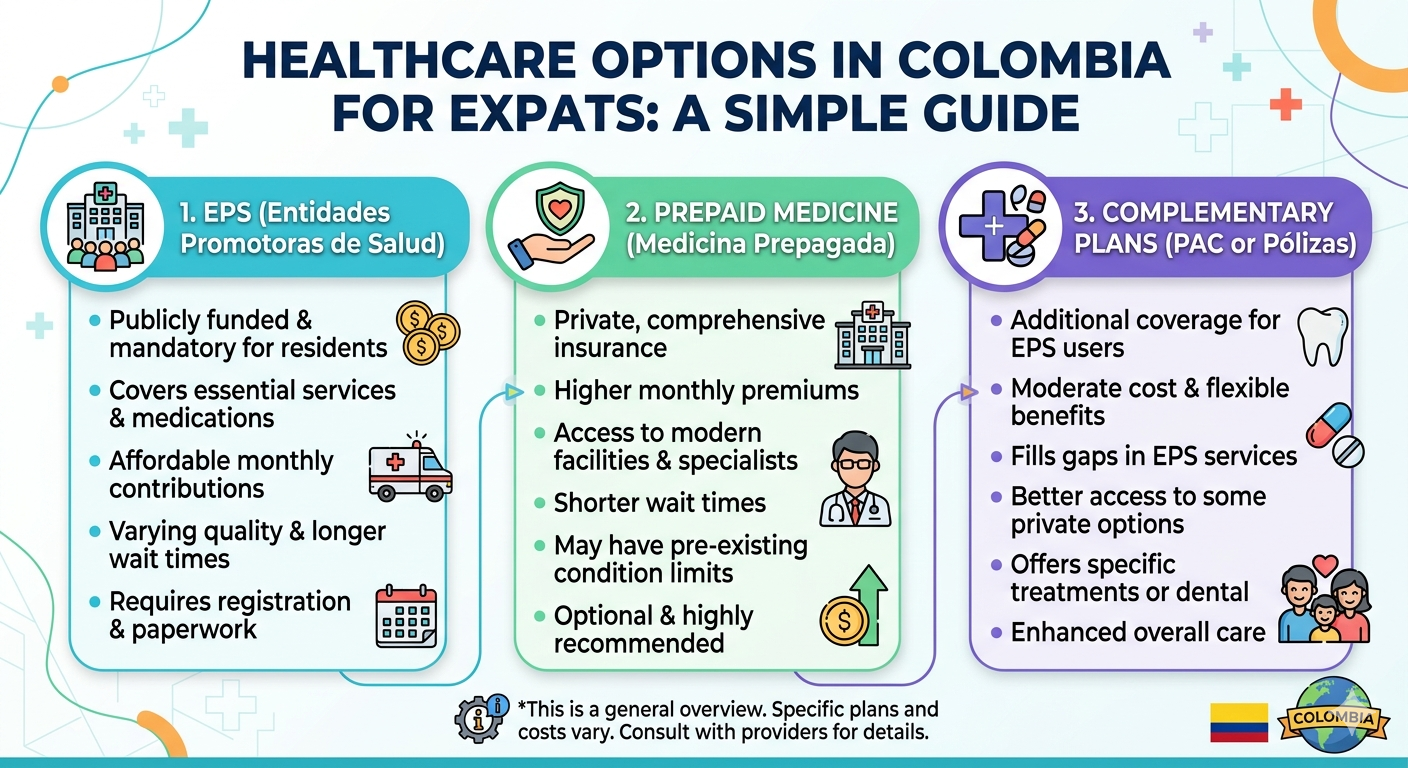
1. How the Colombian healthcare system works
Public system (EPS)
- Mandatory for certain residents
- Funded through contributions
- Mainly used by locals
Private system
Two main layers:
- Prepaid healthcare (medicina prepagada) → requires EPS
- Private / complementary services → do NOT require EPS
(home doctor, ambulance services, emergency support, 24/7 coverage, etc.)
2. Who is legally required to have EPS?
You are required to have EPS if:
- You work for a Colombian company
- You generate income locally
- You are contributing to the Colombian social security system
In Colombia, contributions to the health system are tied to participation in the social security system, particularly in cases of employment or local income.
🔗 (external source: https://www.minsalud.gov.co/salud/Documents/Contenidos/aseguramiento-salud.aspx)
When EPS is NOT required
You typically do NOT need EPS if you are:
- A digital nomad earning abroad
- A retiree with a foreign pension
- A short or mid-term international resident
- International students with global insurance
In these cases, expats rely on international health insurance in Colombia.
3. International Health Insurance in Colombia
Most expats arrive with international health insurance providers like: (IA agrega todos los de a lista que teniamos los 10 que enviamos el email)
- Cigna Global
- AXA Global Healthcare
- Allianz Worldwide Care
- SafetyWing
- IMG Global
- GeoBlue
- Bupa Global
- Genki
An international insurance is mandatory to have a visa as a retiree, student, digital nomad
How it actually works (this is key to do not have frustrations)
There are two models:
Direct billing
Some clinics bill the insurance directly.
Reimbursement (very common)
You:
- Pay upfront when needed
- Submit documents
- Get reimbursed after
This is one of the most important things expats need to understand they need to pay most of the times and then will be remboursed by the insurance. You need to ask always to the provider if your insurance is allowed to pay with.

4. Emergency services and home medical care
There are local services like:
- EMI
- Home doctor services
- Private ambulance providers
They offer:
- Faster response
- Doctor at home
- support for non-critical situations
Very useful for day-to-day healthcare needs. It is important to know the insurance will cover and reinbourse, but some people likes to have an complementary service for peace on mind
5. Practical advice (this will save you headaches)
Before arriving
- Make sure your insurance is active
- Understand coverage and reimbursement
- Check if your insurer has agreements locally and wich whit hospitals
Once you arrive
- Identify 2–3 reliable clinics
- Understand how payments work
- Consider complementary services (home doctor, emergency support)
If you’re not sure how to choose, a relocation agency or concierge service can guide you through providers, options and real-life scenarios.
During your stay
- Keep ALL invoices
- Ask before any procedure
- If needed, get support (translation, appointments, coordination)
You are not alone — having local guidance makes a big difference, especially in the first months.
6. The truth about healthcare quality in Colombia
Yes — rankings have dropped in recent years.
Some international indices, such as CEOWORLD’s Health Care Index, place Colombia lower than expected.
🔗 https://ceoworld.biz/2025/09/21/countries-with-the-best-health-care-systems-2025/
This is largely linked to structural issues affecting the public system (EPS).
BUT — and this is key:
This does NOT reflect the reality of private healthcare in Colombia used by expats. Sadly it affects the local fellows with goberment service
Private healthcare in Colombia remains:
- High quality
- Well equipped
- Internationally competitive
In fact:
- Several Colombian hospitals are included in global rankings such as Newsweek’s World’s Best Hospitals
🔗 https://rankings.newsweek.com/worlds-best-hospitals-2026/colombia - Medellín remains a leading healthcare hub in Latin America
- The city attracts medical tourism from the US and Europe
Top strengths:
- High complexity procedures
- Cardiovascular care
- Aesthetic medicine
- Sports medicine
- Advanced technology
- Plastic cirgury top
- Dental care top rankings
The proof is there are a huge medical turism there and you can look in internet the amount of reviws positive experiences, service providers for medical travels, there are multiple articules, rankings, you can explore how medellin reputation is for medical trips.
Bottom line:
Private healthcare in Colombia works very well.
And as an expat using international insurance:
You are lucky and not exposed to the current weaknesses of the public system. This is not nice and fair to say but I need to be transparent and just reflect the picture in this moment, Colombians had a very good quality and responsive public system, but lately is not passing for its best moemt due a political reasons I am not etering to discuss here.
7. Why complementary healthcare services matter
Even with international insurance, many expats choose to add local services.
Why?
Because international insurance is designed for:
-Serious events (hospitalization, surgery, emergencies)
But not always for:
– Daily, practical, immediate care
What complementary plans give you
- Doctor at home → no waiting rooms
- Fast response → no bureaucracy
- Private ambulance
- Telemedicine 24/7
- Low cost ( yes there are very affordable plans)
- No pre-existing condition barriers
Real logic
International insurance = for the big problem
Local complementary services = for everyday life
👉 Choosing the right combination depends on your profile and lifestyle.
8. Real cost (2026)
Typical monthly cost:
International insurance
- Nomads: $40 – $160+ USD
- Retirees: $150 – $250+ USD
Local complementary services
- $13 – $500 USD ( there are many possibilities in the low range)
Combined total
👉 $65 – $300+ USD/month
For:
- High quality care
- Fast access
- Advanced technology
- Peace of mind
Honestly, for most expats, that’s a very strong value.
9. A common mistake
Many expats assume:
“I have international insurance, so everything will be automatic.”
Reality:
- You need to understand the system
- You need to know where to go in advance
- You will need manage payments
- Not everybody speaks English ( most of doctors, but secretaries, assistants, nurses not)
FAQ
Do expats need EPS in Colombia?
Not always. It depends on whether you work or generate income locally.
Can I use international insurance in Colombia?
Yes, but often through reimbursement, not direct billing.
Is private healthcare in Medellín good?
Yes for expatas and private medicine right now; It is one of the strongest systems in Latin America.
Do I need complementary services?
Not mandatory, but highly recommended for day-to-day care.
Conclusion
Colombia offers excellent healthcare — especially in cities like Medellín.
But the system is a mix of:
- Public
- Private
- International
And without guidance, it can be confusing.
Understanding how everything fits together allows you to:
- Make better decisions
- Avoid surprises
- Access care with confidence
If you want clarity from day one, a short orientation call can save you time, money and stress.