

Living in Medellín as an Expat: The U Curve of Cultural Adaptation
- Written by: Claudia - Settling in Medellín
- 14 September, 2026
- Comments: (0)
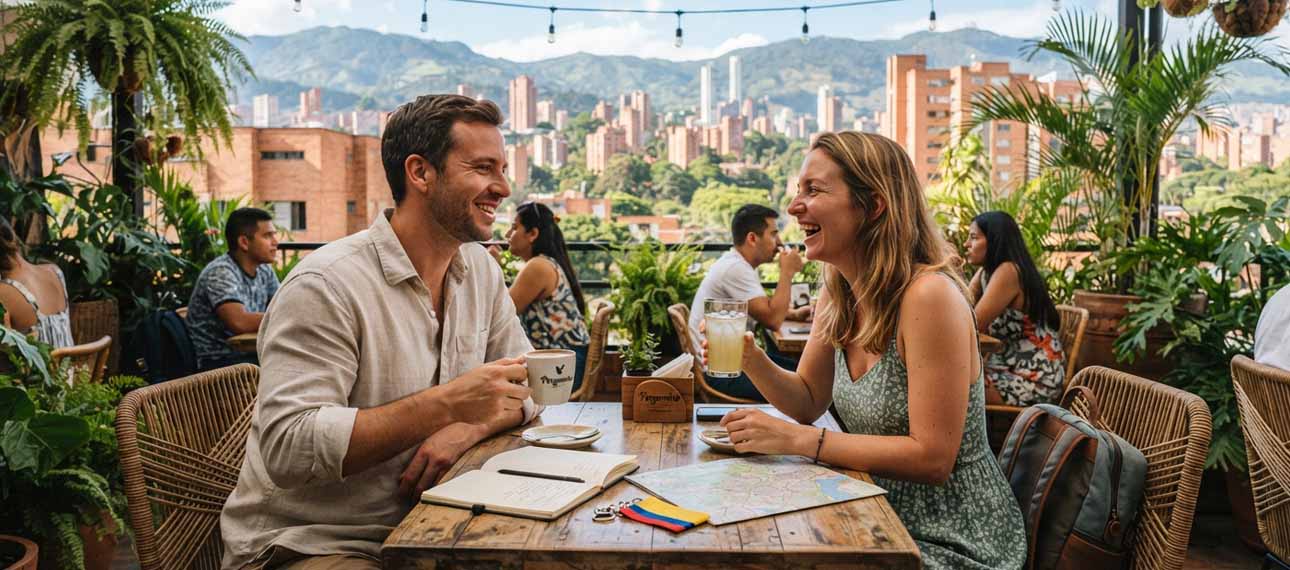
One day you are looking at the mountains from a balcony thinking:
“Medellín, where have you been all my life?”
A few weeks later, you are trying to understand a rental contract, posting your questions in a WhatsApp group and wondering why something that looked very simple somehow requires six different conversations in Medellín.
It is not just you. Or at least, not only you.
Living in Medellín as an expat is not only about finding an apartment, choosing a neighborhood or learning where to get a good coffee. It is also about adapting to a different culture, a different rhythm and a completely new way of doing everyday life.
And that process has been studied for decades.
In 1955, Norwegian sociologist Sverre Lysgaard published Adjustment in a Foreign Society: Norwegian Fulbright Grantees Visiting the United States. He observed a pattern: adjustment could feel relatively easy at first, become more difficult once the initial novelty wore off, and then improve again over time.
Drawn as a graph, that pattern looked like a U.
That idea became known as the U Curve of Cross Cultural Adjustment, one of the classic models used to describe what can happen emotionally when we move into a new culture.
A few years later, anthropologist Kalervo Oberg published his influential work on culture shock, describing the process of adapting to a new cultural environment. His 1960 article became another foundational reference for understanding the different stages people may experience after moving abroad.
The U Curve of Cultural Adaptation
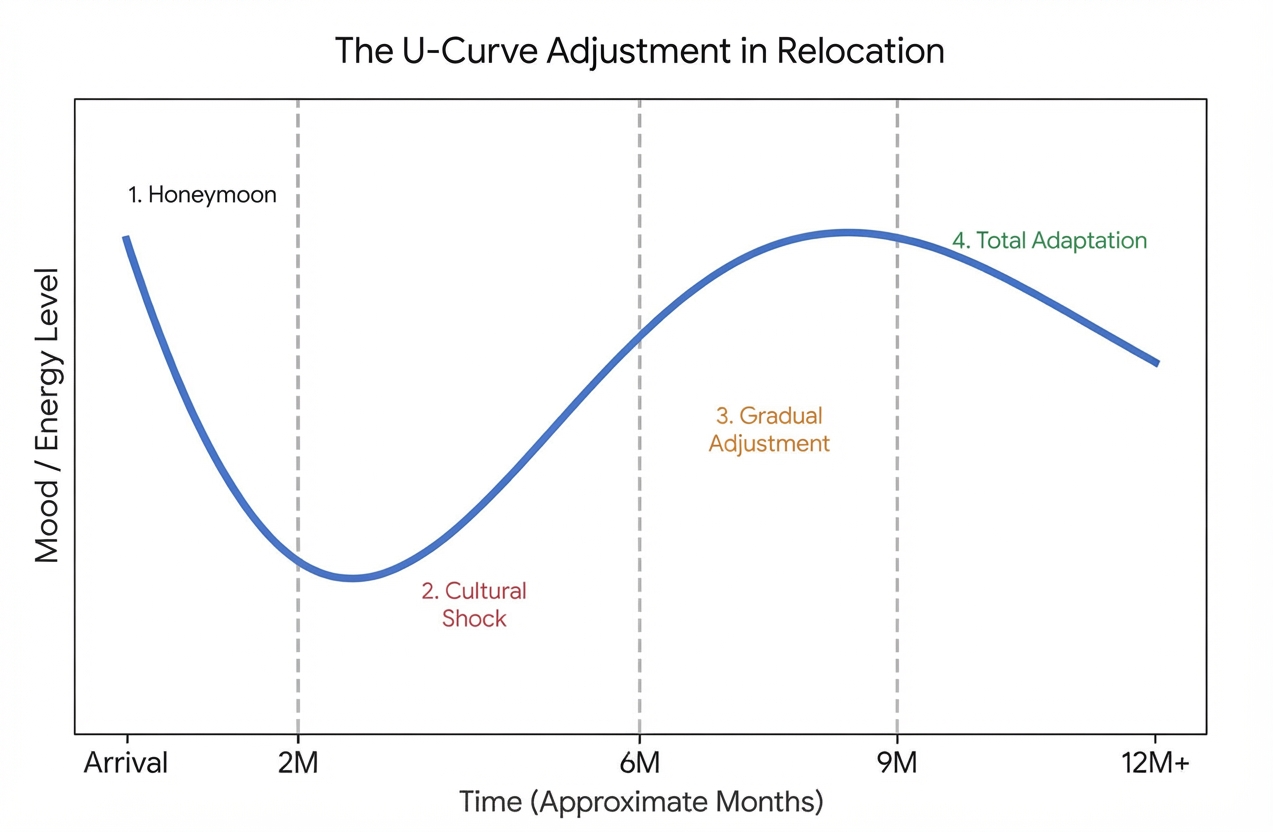
Of course, people are not graphs.
Not everyone follows the same curve, at the same speed or even in exactly the same order. Research on cross cultural adjustment has also shown that real life adaptation does not necessarily follow a perfect U for everyone.
Still, as a way of understanding the emotional highs and lows of starting a life in another country, it remains remarkably relatable.
And when that country is Colombia and that city is Medellín, parts of the curve can feel very familiar.
1. Honeymoon: Medellín, where have you been all my life?
You arrive.
You come down from the airport, the mountains appear and the city opens up in front of you.
The weather helps. The greenery helps.
The terraces make you fall in love a little more.
You discover Laureles, El Poblado, Manila and Envigado. You find beautiful cafés, try fruits whose names you still cannot remember, save far too many restaurants on Google Maps and think:
“Medellín, where have you been all my life?”
Everything feels new and exciting.
Even apartment hunting can seem fun. Enjoy it. Absolutely. Just do not rush.
It is all very la vie en rose. The accent sounds musical, the service feels warmer than expected, the flavors are intense, the music is everywhere and, honestly, life looks pretty damn good.
And that is exactly where the honeymoon stage can trick you:
You are looking at Medellín with a visitor’s eyes while starting to make a resident’s decisions.

2. Culture shock: wait… how does this actually work?
And then…
That spectacular apartment with the incredible view may feel slightly less spectacular the morning after you move in and discover that buses start passing noisily under your balcony at 5 a.m.
Or that the construction next door, which you barely noticed during the viewing, means vacuuming three times a week.
Or that the “short walk to the supermarket” involves a hill that probably requires climbing equipment, an energy shot and a moment to catch your breath when you finally make it to the top.
For newcomers, the smartest recommendation is often to start with temporary accommodation and give yourself time to understand Medellín before committing to a long term contract.
Because choosing where to live here is not only about choosing a beautiful flat.
It is about understanding what your quality of life will actually look like.
Discover our service for Short Term Accommodation Search
Then real life begins.
You are no longer deciding only where to have dinner.
You need to solve things, put out a few fires and sometimes make important decisions in record time, with consequences you do not fully understand yet.
And you quickly discover that speaking enough Spanish to order a beer is not necessarily the same as speaking enough Spanish to negotiate a lease.
Processes work differently.
And Google Translate does not always know how to interpret paisa slang.
You read the words and think:
“OK, but what does he really mean?”
Bureaucracy is different and can feel overwhelming.
Timing is different too, and their concept of time can take a little while to assimilate.
Communication is not always precisely precise either.
Maybe you are literal and they are flexible.
You are waiting for an exact date and someone tells you:
“Middle of September.”
Middle of September?
Your brain wants a day, a time and preferably a calendar invitation.
This is where things can become both fascinating and, occasionally, maddening.
If you come from a culture that is more structured, direct or attached to exact data and concise answers, your brain may suddenly find itself in full culture shock.
A paisa may give you a wider window of time, decorate a story, use a saying you have never heard in your life, throw in a comparison that makes absolutely no sense to you, or use a perfectly normal local exaggeration that your foreign brain tries to interpret literally.
You can understand every word and still not quite understand what was actually meant.
Cultural differences feel charming when you are on holiday.
They can feel considerably less charming when they start affecting your money, your time, your paperwork or your daily routine.
You may miss how easy certain things were back home.
You may get frustrated.
You may even wonder whether moving was such a brilliant idea after all.
Welcome to culture shock.
Medellín did not suddenly change.
You are simply no longer on vacation.
3. Adjustment: ahhh… now I get it
Little by little, the pieces start falling into place.
You know which areas work for you and which definitely do not.
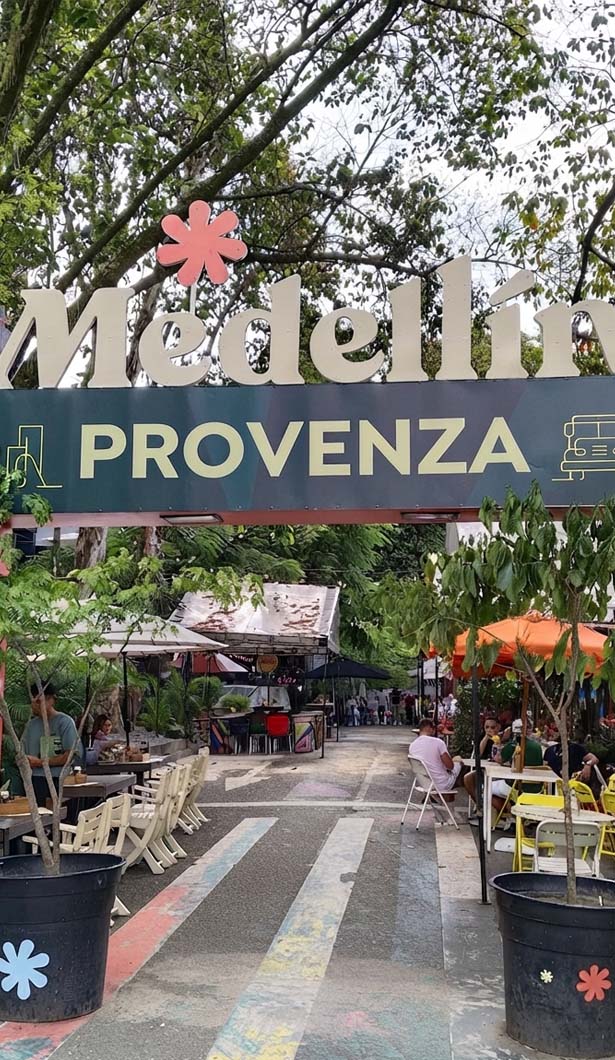
You also understand that Manila, Provenza, Los Balsos, La Aguacatala and Vizcaya can offer completely different day to day experiences, despite all being part of what people casually call “Poblado.”
You know when traffic is going to be impossible and when it is simply better to sit down and have another coffee.
You have your supermarket, your gym, your favorite bar and probably someone at the little neighborhood shop who already knows what you buy.
You have also learned one of the most important relocation lessons:
The best home is not necessarily the prettiest one. It is the one that works for your real life.
Maybe you arrived convinced that El Poblado was for you and ended up much happier in Laureles, Ciudad del Río or Envigado.
Maybe you thought the dream was a panoramic view and now your number one priority is simply being able to walk everywhere.
The city did not become simpler.
You learned how to navigate it.
But there may still be some errands pending, some procedures where you prefer support and a few missing pieces in the puzzle before you truly feel that everything fits.
Sometimes a helping hand is still welcome.
And that is perfectly OK.
You do not need to feel ashamed of asking for help just because you have already been here for a while.
4. Mastery and Integration: when Medellín stops feeling temporary
And then one day it happens without much ceremony.
You stop constantly saying:
“In Colombia they do this differently.”
You simply know the flow.
You have favorite places, routines and a social life.
You know who to call, where to go, which things are worth worrying about and which are absolutely not.
And perhaps now you are the person answering the questions you were asking months ago.
That is the beautiful part of cultural adaptation.
Medellín starts becoming part of your mindset.
It does not mean losing who you were or suddenly becoming Colombian.
It means you have learned to move between different cultural references, and the city has become part of your own adapted lifestyle.
Making it through the bottom of the U Curve and climbing back up is a whole journey.
And it is about so much more than finding a flat.
Settling well means understanding a thousand little things: how the city works, what your real options are, which signals to pay attention to, what is normal and what is not, where you feel comfortable, and which decisions make sense for your particular way of living and feeling truly at home.
We cannot remove culture shock, but we can make the curve shorter and softer.
Actually, we would not want to remove it completely.
One of the best parts of moving abroad is discovering that there are other ways of doing things, learning them, questioning them and gradually finding your own way somewhere in between.
As human beings, we naturally resist change.
Our brains love the comfort zone. Accepting new ways of doing things takes effort. That discomfort is a very human part of adaptation.
But the challenging part of the curve does not have to be quite so challenging.
With the right information, local tips and a few useful shortcuts, the path can become softer, easier and even fun.
You can reduce some of the discomfort of adjustment by having the right tools and information before a small issue becomes a big frustration.
And perhaps avoid a few expensive mistakes and too many moments of:
“Why did nobody tell me this before?”
“There was a shortcut for this?”
“I would have been so much less frustrated if someone had simply explained this to me.”
“My landing would have been much softer if I had known.”
If you are starting to feel a little overwhelmed, Settling in Medellín can become the trusted local team that supports you on the ground.
Your guardian angel before landing.
Your support after arrival.
And even a helping hand when it is time for a soft departure.
Think of us as your local godparent, the person you can ask all those questions you do not know who else to ask.
Instead of asking ten different WhatsApp groups and ending up with fifteen different opinions, you get clear answers in one place.
Efficient, no? Time is gold.
- Is this really a fair asking price? How do I know?
- Is it normal for a landlord to ask for this?
- Who is protecting my interests or advocating for me?
- Could getting the right support at the beginning save me a headache later?
- Is a deposit legal?
- Can I manage the visa process myself?
Sometimes one good local answer can save you ten WhatsApp conversations, three wrong decisions and a very expensive lesson.
Take advantage of our free courtesy video call to help guide your arrival, your life in Medellín or even your departure.
Bring your doubts.
Bring your worries.
Bring your entire list of questions.
We will help you make sense of them in this introductory video call.
References
Lysgaard, Sverre (1955). Adjustment in a Foreign Society: Norwegian Fulbright Grantees Visiting the United States. International Social Science Bulletin, Vol. 7, No. 1, pp. 45 to 51.
Oberg, Kalervo (1960). Cultural Shock: Adjustment to New Cultural Environments. Practical Anthropology, Vol. 7, No. 4, pp. 177 to 182.
Contact us today and discover how we can make your arrival in Colombia simple, fast, and completely worry-free.
Our team is ready to guide you through every step of the process, offering personalized solutions for executives, multinational companies, expatriates, and digital nomads looking to successfully settle in Medellín.